



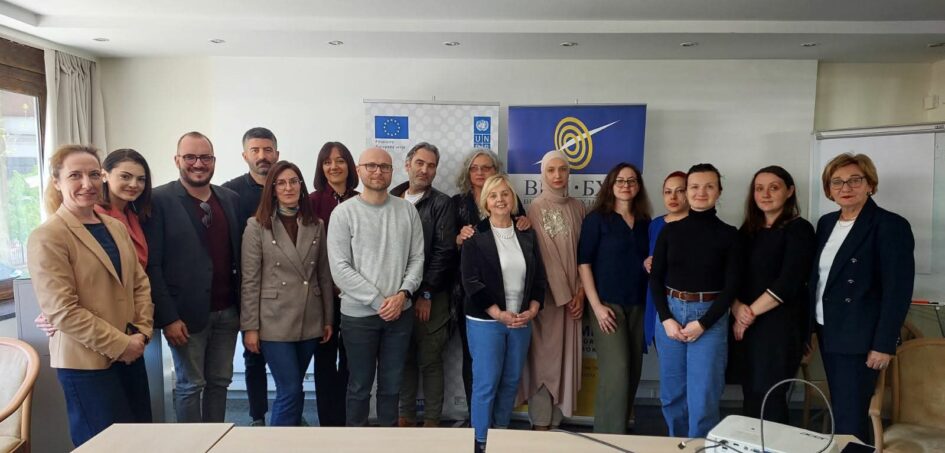
Sarajevo, April 24, 2026. – The importance of addressing the legacy of the 1990s conflicts through responsible journalism, academic engagement and regional cooperation was at the center of a three-day seminar held in Sarajevo from April 22 to 24, 2026. The event, organized by the BH Journalists Association (BHJA) in cooperation with the Independent Journalists’ Association of Serbia (NUNS) and the Media Trade Union of Montenegro (SMCG) as part of the regional project Academy of Transitional Justice, brought together journalists, editors, university professors and representatives of civil society organizations from Bosnia and Herzegovina, Serbia and Montenegro.
The Academy of Transitional Justice is a regional educational program designed for journalism and communication students, editors and professors that aims to strengthen cross-border cooperation, dialogue and knowledge exchange, while promoting the principles of transitional justice, reconciliation, respect for victims and fact-based understanding of war crimes and the legacy of the 1990s. Through its activities, the Academy also seeks to strengthen professional and ethical journalism standards, encourage responsible reporting on war-related topics, and support the integration of transitional justice principles into academic curricula across journalism faculties in the region.
During the three-day seminar, participants discussed a range of topics related to dealing with the past and transitional justice in the region. Hrustan Šišić, professor at the International Burch University in Sarajevo, in his presentation spoke about understanding civic activism and protests in Bosnia and Herzegovina and whether transitional justice in BiH is unfolding in the same way as in other countries in the region.
“We live in a divided society, in which little or no space is left for people who fight for transitional justice. The burden of that struggle has been placed on the shoulders of the non-governmental sector and the academic community, while we are not decision-makers. The specificity of Bosnian society lies in the fact that there are three parallel narratives and a complex political system in which the capacity to seek truth is initially low. In centralized societies that capacity is higher, but it does not guarantee the right direction”, Šišić said.
Participants of the seminar agreed that dealing with the past must be an authentic process and that the role of the international factor in this regard should not be a defining one. In this context, the role of the media and journalists is particularly important, as they significantly influence how topics from the past are perceived by the public.
“People often tell us that these are ‘difficult’ topics that no one is interested in anymore, that more than 30 years have passed, etc. On the other hand, victims and their families expect and need support. In BiH, more than 7,000 missing persons are still being searched for, and interest in this issue today is even lower than in war crimes trials. However, regardless of the passage of time, which inevitably does its part, as journalists we have an obligation to report on these stories and develop a culture of remembrance”, said Džana Brkanić, editor at the Balkan Investigative Reporting Network (BIRN).
One of the topics was the importance of a gender perspective in the culture of remembrance and the role of the academic community in this process. Differences in how men and women remember war events and relate to the past were emphasized by professors Zilka Spahić Šiljak from Sarajevo and Aleksandar Savanović from Banja Luka.
“One of the important questions is who has the right to interpret the past, that is, to speak about the past in the public space? The culture of remembrance is not neutral at all, and especially not gender-neutral. It is always connected to systems of power and is systematically implemented through various events, commemorations, within the academic community… That space of commemoration is at the same time a space of conflict, and what belongs to the past determines how we live in the present”, said professor Spahić Šiljak, while prof. Savanović emphasized that historical revisionism and transitional justice in our region have turned into a kind of social paranoia in which it becomes impossible to distinguish reality from fiction.
The seminar concluded with a shared understanding that much firmer regional cooperation with strengthening critical, ethical and inclusive approaches to reporting on the past among journalists, academics and media organizations remains essential for building a more responsible society that can contribute to long-term reconciliation and social trust in the region.
The seminar in Sarajevo was organized within the framework of the “Academy of Transitional Justice” project and supported through the Regional Program “EU Support to Confidence Building in the Western Balkans”, implemented by the United Nations Development Programme (UNDP) and funded by the European Union (EU). The content and topics of the seminar are the sole responsibility of BH Journalists and do not necessarily reflect the views of the European Union or UNDP.
Author: BH Journalists


