



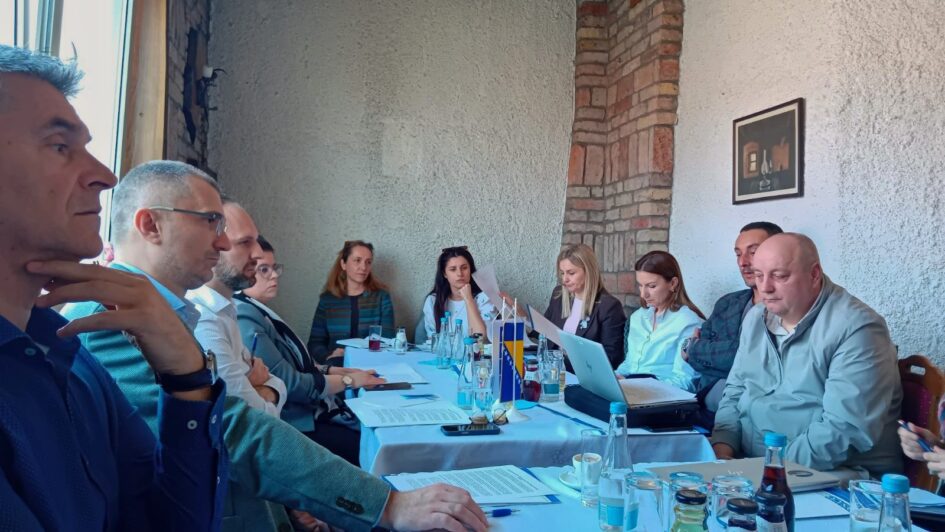
East Sarajevo, 11 March 2026 – Since the beginning of 2026, the Ministry of Interior of Republika Srpska (RS) has received five reports of threats against journalists, said Mirna Miljanović, Head of the Public Relations Department of the RS Ministry of Interior and the contact person for the safety of journalists, at a working meeting with journalists held today in East Sarajevo.
 The meeting was organized by the OSCE Mission to Bosnia and Herzegovina and brought together “contact points” for the safety of journalists from the RS Ministry of Interior and the District Public Prosecutor’s Office in East Sarajevo, journalists from East Sarajevo, Pale and Višegrad, as well as representatives of the BH Journalists Association and Umbrella Association of Journalists in Bosnia and Herzegovina.
Mirna Miljanović stated during the meeting that around 70% of attacks on journalists occur on social media, emphasizing: “These investigations take longer because the perpetrators often do not live in Bosnia and Herzegovina, and the law requires the police to take statements from all parties involved in the proceedings. Although these investigations take longer, they are carried out intensively. Recently, we arrested a person at a border crossing who had threatened Dragan Bursać via social media in 2023.”
Nemanja Sladoje, prosecutor and contact person for the safety of journalists at the District Public Prosecutor’s Office in East Sarajevo, emphasized that the line between a misdemeanor and a criminal offense is thin in cases of attacks on journalists.
“The difference lies in the seriousness of the threat. In criminal offenses, the threat must be directed at the life or physical integrity of the injured person or someone close to them,” Sladoje explained, adding that the seriousness of a threat is also assessed based on who the threat comes from.
The journalists present pointed out the problems they face when reporting threats and other forms of violence encountered in the course of their work, stressing how important it is that the officer receiving the report understands the specific nature of journalistic work.
“Journalists do not have the luxury of being absent from work for long periods in order to comply with all procedures when reporting an attack, and they often lack trust in institutions to conduct an investigation and punish the perpetrator,” it was said during the meeting.
 Representatives of the judiciary and police repeatedly emphasized that reports of threats and attacks must be submitted personally by journalists at police stations or prosecutor’s offices, and that they must clearly state that they are journalists. It often happens that the police or prosecutors classify the act as a misdemeanor, which journalists in some cases perceive as a “downplaying” of the consequences of attacks on journalists’ safety or as a “permission” for threats and attacks to continue. They cited this as another reason for distrust in institutions.
Borka Rudić, Secretary General of the BH Journalists Association, emphasized that some progress has been made in reducing impunity for attacks on journalists since the establishment of “contact points” for journalist safety, and that in some judicial institutions in Bosnia and Herzegovina these cases are being processed with greater attention.
“In 2025, courts issued 11 rulings in favor of journalists, which is the highest number of rulings in a single year since BH Journalists began monitoring. Not all of these cases originated last year, but earlier; however, this still indicates positive progress in the efficiency of the judiciary and the number of resolved cases,” said Rudić. She added that work should continue on “harmonizing the handling of threats and attacks cases across Bosnia and Herzegovina,” and that negative experiences with individual members of police or prosecutor’s offices should not diminish the progress that has been achieved.
 All participants of the working meeting agreed that there is room for improvement in ensuring the safety of journalists, that threats must be reported to the police, prosecutors, and journalists’ associations, but also that journalists should not abandon the cases they report or withdraw complaints.
Since the beginning of 2026, the Free Media Help Line has received 11 reports of violations of journalists’ rights. Within the framework of the free legal aid provided by the BH Journalists Association, there are currently 26 active cases before courts in Bosnia and Herzegovina and one case before the European Court of Human Rights. The Free Media Help Line has a network of 22 lawyers across Bosnia and Herzegovina who can provide journalists with legal advice or legal assistance when giving statements to the police, during hearings, or represent them before courts in cases of defamation or violations of labour rights. Journalists also have access to free psychological support. Threats, attacks, pressure, and violations of labour rights can be reported via an online form.
The working meeting “Safety of Journalists” in East Sarajevo is one of a series of meetings being held across Bosnia and Herzegovina to familiarize journalists with the role of contact points in prosecutor’s offices and ministries of interior, and to exchange information about the challenges they face.
Author: Mirna Stanković Luković
Foto: BH Journalists, private archive


