



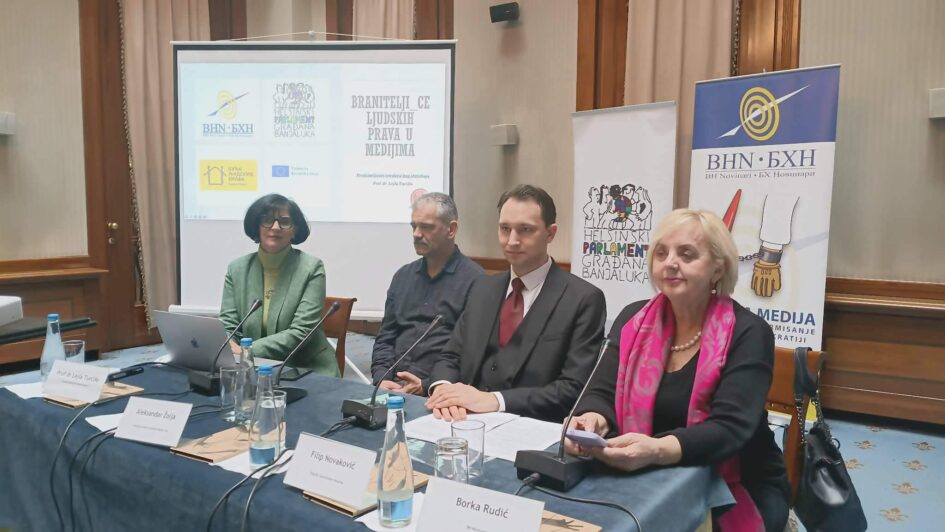
Sarajevo, 30 January 2026 – Human rights defenders in Bosnia and Herzegovina have been operating for years in an environment marked by continuous pressure, threatsand attempts at discreditation, with such attacks often coming from public officials and political actors. This was emphasized today in Sarajevo during the presentation of the monitoring report on the rights and security of human rights defenders, as well as the results of the two-year operation of the Help Line for Human Rights Defenders in Bosnia and Herzegovina. The event was organized by the Helsinki Citizens’ Assembly Banja Luka and the BH Journalists Association.
Over the past two years, the Help Line for Human Rights Defenders has handled 17 cases – two of which were resolved in favour of the defenders, three partially, while seven cases are still ongoing. At the same time, hundreds of initiatives were submitted to domestic and international human rights protection institutions. Prior to the establishment of the Help Line, Bosnia and Herzegovina had no dedicated mechanism to provide free legal or other forms of support to human rights defenders, nor was their status clearly defined within the institutional or legal framework.
 “We want to clearly convey that human rights defenders are not alone. The Help Line will continue operating even after the formal end of the project, with a team of 15 in-house lawyers and 12 attorneys deployed across Bosnia and Herzegovina, ensuring that assistance is available to defenders from all parts of the country – in Banja Luka, Mostar, Tuzla, Bijeljina, Sarajevo…,” said Žolja.
Human rights defenders are frequently exposed to SLAPP lawsuits and lengthy court proceedings that they are unable to sustain financially without support.
“The state very often does not stand behind them and frequently appears as an opponent. Our role is to provide legal and institutional support where it is lacking,” Žolja emphasized.
Lawyer and Help Line Coordinator Filip Novaković explained that the Help Line was not designed as a substitute for existing institutions, but rather as an additional mechanism of solidarity and support.
 “The Help Line is not a corrective to the existing system, but a message to defenders that, at a crucial moment, someone stands behind them,” Novaković said.
He also pointed to the issue of pronounced institutional passivity, noting that in many cases they face administrative silence, particularly when politically sensitive issues are involved, and that “prosecutor’s offices often fail to inform complainants about the status of their cases, thereby further violating their rights.” Novaković also stated that a draft law on the protection of human rights defenders is currently being prepared, which could make Bosnia and Herzegovina the first country in Europe to adopt a specific law in this field.
“Only a very small number of countries worldwide have such a systemic law. Bosnia and Herzegovina has the opportunity to lead in Europe and set standards for the protection of human rights defenders,” Novaković concluded.
 Professor Lejla Turčilo from the Faculty of Political Sciences in Sarajevo presented the results of research on media coverage of human rights defenders. The analysis showed that such reporting is often occasional, mainly tied to campaigns or individual events, and most frequently limited to daily news and reports from activities organized by the defenders themselves. However, as Turčilo noted, there are also examples of highly professional and high-quality media reporting, particularly in cases where human rights defenders need public support.
According to her, sensationalist headlines and a negative tone in reporting on human rights defenders result in an increased number of comments containing hate speech, incitement, and discrimination.
“This is nothing new, but it is useful to see it demonstrated on a representative sample, and for it to start calling the media to account not only for how they report, but also for how they frame these topics – through headlines, photographs, visuals, and similar elements. The more professional we are, the more appropriate the public’s attitude will be toward these extremely important issues,” Turčilo stressed.
 The Help Line for Human Rights Defenders began operating in 2024 with financial support from the European Union, with the aim of providing free legal assistance and urgent expert support to human rights defenders in Bosnia and Herzegovina who face violence, attacks, and threats due to their work in protecting and publicly advocating for human rights. The establishment and strengthening of the Help Line was jointly implemented by the Helsinki Citizens’ Assembly Banja Luka and the BH Journalists Association.


