


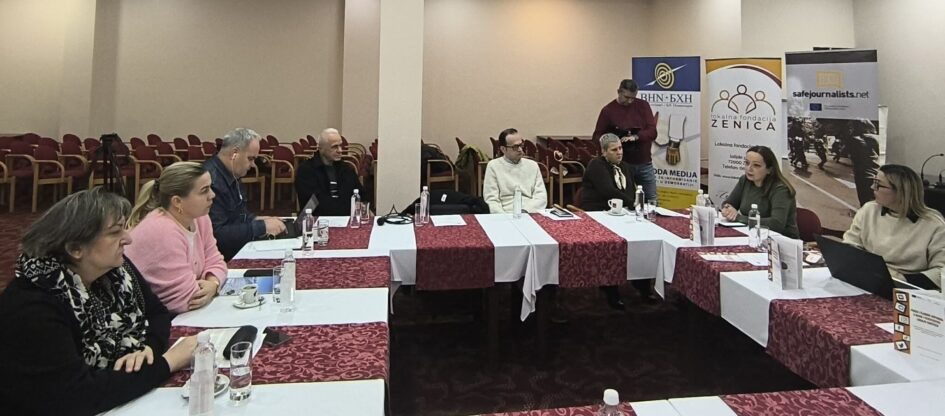
Zenica, 14 January 2026 – The Local Foundation Zenica (LFZ) presented the first report on the state of media freedoms in the city entitled “Rights and Freedoms of Journalists in Bosnia and Herzegovina: Local Context”.The report was produced within the project “Strength of the Community: Saying NO to the Violation of Journalists’ Rights and Safety in Local Communities”, with the support of the regional SafeJournalists Network and in cooperation with the BH Journalists Association (BHJA).
The report provides a systematic overview of the state of journalists’ rights and freedoms in Zenica and the Zenica-Doboj Canton. It includes personal experiences and observations of journalists, as well as findings derived from a series of information sessions and workshops held throughout 2025.
“It is indicative that out of the total number of reported cases, as many as nine journalists were exposed to violations of their professional rights or attacks by elected officials—whether mayors, councilors, or other public officials. Eight journalists reported violations of the right to freedom of access to information, while one person experienced a physical attack. One quarter of the surveyed journalists were subjected to violations of their rights by their superiors, namely their editors”, said Velida Kulenović, the author of the report, president of the Zenica Journalists’ Club and a member of the Steering Committee of the BHJA.
Kulenović added that it’s particularly concerning that most journalists do not report violations of their rights, which may stem from fear, insufficient knowledge of their rights, or a lack of trust in institutions. Moreover, of the ten reported cases of violations of journalists’ rights and freedoms, more than half – six cases – had no concrete outcome. This clearly points to a serious problem in the effectiveness of existing protection mechanisms and the processing of reported cases.
The Executive Director of the Local Foundation Zenica, Amra Smriko, emphasized that the presentation of this report confirms the commitment of the civil society sector to cooperation with the journalistic community, as well as the clear need for greater understanding of the challenges journalists face in their daily work.
“From the perspective of the civil sector, we wanted to make available the resources we have within the community and help in a process that is far from easy and requires the involvement of all stakeholders in order to improve journalists’ rights and freedoms. Journalists are one of the pillars of the local community, and their work, especially in today’s circumstances, is by no means easy”, Smriko stated.
According to Maja Radević, a representative of the Association of BH Journalists, the past year was among the most challenging and difficult for journalism in Bosnia and Herzegovina.
“In 2025, the SafeJournalists Network database registered 35 cases of attacks and threats against journalists, media outletsand journalists’ organizations, including four physical attacks on journalists. At the same time, the Free Media Help Line (FMHL) operated by BH Journalists recorded more than 50 different incidents, including verbal pressure, threats, attacks, labor disputes and attempts at censorship. In the past year, as in previous years, political pressure on journalists and media in local communities was particularly pronounced. This is also one of the most difficult periods for the media in economic terms – last year, due to the suspension of USAID support, many media outlets were forced to significantly reduce staff, the public broadcaster BHRT is on the brink of survival, Al Jazeera Balkans has shut down and hundreds of media workers have lost their jobs”, said Radević.
The report presented in Zenica shows that most violations of journalists’ rights are motivated by attempts to suppress criticism of authorities, ignorance, intolerance, or personal retaliation. The main perpetrators are political officials, superiors and individual citizens. Insufficient awareness among journalists about their rights, weak preventive mechanisms within media organizations and the limited effectiveness of local institutions further complicate the protection of media freedoms.
Therefore, it is necessary to combine two key dimensions: education of all stakeholders (journalists, editors, local authorities, and the community) on rights, protection mechanisms, and responsibilities, and practical support through the establishment of effective protection mechanisms, the development of legal assistance and solidarity network. Only through such a comprehensive strategy, the authors conclude, is it possible to improve journalists’ safety, ensure freedom of expression and strengthen media freedoms in the local community.
The source: BH Novinari


