



Sarajevo, 26 May 2026 – Bosnia and Herzegovina, with a score of 2.61 on the Journalist Safety Index, is currently among the lowest-ranked countries in the region, with only Serbia recording a worse situation during the past year. At the same time, data from Reporters Without Borders confirm the continued deterioration of media freedoms in Bosnia and Herzegovina, which was ranked 90th in the latest World Press Freedom Index — its worst ranking in the past 25 years.
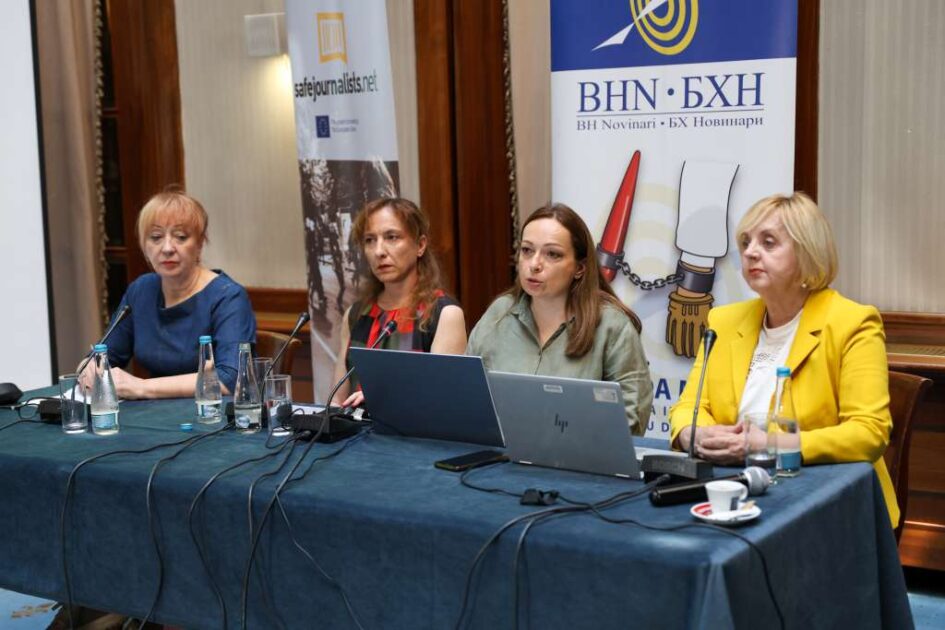
This was highlighted today at a press conference organized by BH Journalists Association and the SafeJournalists network, where the reports Journalist Safety Index in BiH for 2025 and Safety of Women Journalists and Other Women in the Media in BiH During 2025 were presented.
SafeJournalists network researcher for BiH, Maja Radević, emphasized the key conclusion that the space for free and safe journalistic work in Bosnia and Herzegovina continues to shrink, despite certain positive developments, particularly regarding cooperation between police and judicial institutions and the journalism community, as well as the prosecution of attacks against journalists. She stressed that the environment in which journalists and other media workers in BiH operate continues to be marked by political pressure, institutional insecurity, increasing online violence, economic exhaustion of media outlets, and a very low level of trust in the protection system.
“This report shows that pressure on journalists in BiH is no longer reflected only through open threats and physical attacks. It now comes through growing attempts at political discreditation, abuse of institutions, court proceedings and economic coercion against media outlets, as well as attempts to introduce restrictive laws and organized online hate campaigns targeting certain media and journalists,” said Radević.
She added that pressure on journalists is becoming more sophisticated, continuous, and dangerous every year.
Speaking about the legal and organizational environment, she noted that during 2025, professional and working conditions for journalists deteriorated further, especially in private media outlets. She also reminded attendees that authorities made no progress last year in ensuring the long-term financial sustainability of BHRT, which found itself in the most difficult crisis since its establishment.
She described the continued pressure on journalists and media through legislative mechanisms as particularly concerning.
Radević stated that there are currently around 300 active defamation lawsuits in BiH, nearly one-third of which bear the characteristics of SLAPP lawsuits — lawsuits aimed not at protecting reputation, but at financially exhausting and intimidating journalists and editorial offices.
At the same time, she emphasized that certain attempts to further restrict media freedom during 2025 were stopped thanks to strong reactions from the journalistic community and civil society.
Among these was the so called “Foreign Agents Law” in Republika Srpska, which was annulled by the Constitutional Court of Bosnia and Herzegovina after numerous warnings that such legislation posed a serious threat to freedom of expression and the work of independent organizations and media.
Discussing journalist safety, Radević said that during the past year, the Free Media Help Line operating within the BH Journalists Association recorded more than 40 cases of violations of journalists’ rights and media freedoms, while the regional Safe Journalists platform documented a total of 35 security incidents and threats against journalists and media in the country — six more than the previous year.
“However, it should be emphasized that these are not final figures because only about 25 percent of recorded threats against journalists are actually reported to the judiciary and police,” she stressed.
She also recalled that five cases of physical attacks on journalists and media workers in BiH were reported last year, two more than in 2024.
According to her, three cases of threats to the lives and physical safety of journalists were also recorded, two of which involved threats made through social media.
Radević also pointed to certain positive developments regarding the prosecution of attacks against journalists.
She explained that the existence of 33 contact points for journalist safety within police departments and prosecutor’s offices — tasked with prioritizing investigations and recording attacks against journalists — has partly led to improved communication and greater understanding of the specifics of journalistic work within judicial institutions, as well as increased sensitivity among prosecutors and police officers to the security challenges faced by media workers.
She particularly stressed that BiH, with a score of 2.61, is currently among the worst-ranked countries in the region on the Journalist Safety Index.
“The situation was worse only in Serbia during the past year, where journalists and media covering mass protests were exposed to attacks and repression by authorities,” she added.
In conclusion, she warned that data from Reporters Without Borders confirm the continued decline of media freedoms in the country.
“According to the latest Reporters Without Borders report, BiH is ranked 90th on the World Press Freedom Index, representing the lowest level in the past 25 years, whereas only three years ago BiH was ranked 64th,” Radević pointed out.
Free Media Help Line (FMHL) coordinator Mirna Stanković Luković presented an analysis covering the period from January to December 2023, noting that quantitative data were collected from the Safe Journalists network database and records of the BH Journalists Association’s Free Media Help Line regarding attacks and threats directed at women journalists.
She explained that qualitative data were gathered through desk research, reviews of public reports and documents, interviews, and insights obtained during focus groups with women journalists.
According to her, the discussion covered three key areas: the position of women journalists within newsrooms, pressures and threats coming from outside the media sector, and experiences with gender-based violence and harassment.
She said that reported cases of threats and attacks, as well as court proceedings, illustrate broader patterns in the security environment for women journalists and indicate certain progress, but also persistent shortcomings in institutional responses.
Speaking about the protection of women journalists and media workers in BiH, Stanković Luković emphasized that the country has taken certain steps toward harmonizing its legal framework with international standards in the field of gender-based violence, particularly those arising from the Istanbul Convention.
However, she stressed that existing legal and political mechanisms still fail to adequately address the specific risks faced by women journalists, recalling that implementation of the amended Criminal Code began in the Federation of BiH during 2023.
She also pointed out that institutional responses remain inconsistent, while legal support is primarily available through civil society organizations.
“Internal support mechanisms within media organizations remain limited,” she added.
Discussing trends in attacks, threats, and harassment during 2023, she stated that a total of eight cases of threats and attacks against women journalists in BiH were registered, representing the most common form of incidents.
She emphasized that women journalists are often targeted with attacks focused on their physical appearance, private lives, or morality rather than their professional work.
“Online harassment remains one of the most widespread forms of violence against women journalists in BiH,” she underlined, adding that around 70 percent of reported attacks against journalists occur online.
She also noted that this year, from January until now, there have been two physical attacks against women journalists, while the remaining cases mainly involved threats and public targeting, including online targeting.
Stanković Luković assessed that institutional responses are still inconsistent.
“Many incidents continue to face slow investigations, limited prosecution, and inadequate protective measures,” she said.
She stressed that underreporting remains a major challenge because many women journalists choose not to report threats due to distrust in institutions and insufficient support within editorial offices.
Speaking about recommendations, she said that policymakers and decision-makers should develop a national strategy or action plan specifically focused on the safety of journalists and women journalists, ensure consistent implementation of criminal law, and improve data collection to secure adequate statistics.
She also noted that professional associations and trade unions should strengthen their own mechanisms, while civil society and international actors should continue supporting monitoring and advocacy initiatives related to journalist safety.
Human Rights Ombudswoman of BiH Jasminka Džumhur emphasized that, as an institution mandated to monitor freedom of expression through freedom of access to information, they wanted to point out two segments considered particularly significant.
She stressed that freedom of expression does not only imply citizens’ right to receive information, but also protection of the channels through which that information is distributed.
She added that certain problems are not sufficiently recognized in reports but are visible through cases considered by the institution.
As the first problem, she highlighted restrictions on access to public services, institutions, parliaments, and similar bodies, stressing that such practices limit the working conditions of media and the public’s right to information.
As the second important issue, she pointed to the increasing vulnerability of journalists, especially women journalists, in the digital sphere.
Speaking about additional challenges, Džumhur also warned about what she described as persistent ignorance of the need to define and regulate the media space. According to her, the lack of clearer regulation creates room for abuse of media space as a public good by certain media outlets that are not always willing to act in accordance with professional media principles.
Secretary General of the BH Journalists Association, Borka Rudić, noted that the association had launched an initiative together with the European Federation of Journalists to establish a journalists’ trade union in BiH.
“This will be a two-year process focused on the entire region because we have problems protecting labor rights. The European Federation has finally managed to secure funding in Brussels, and we will launch these issues across the whole region,” she said.
Rudić concluded that it is particularly important that there will be opportunities to establish journalists’ unions, train union activists, and create union organizations in areas where they currently do not exist.
(Source: Fena)


