


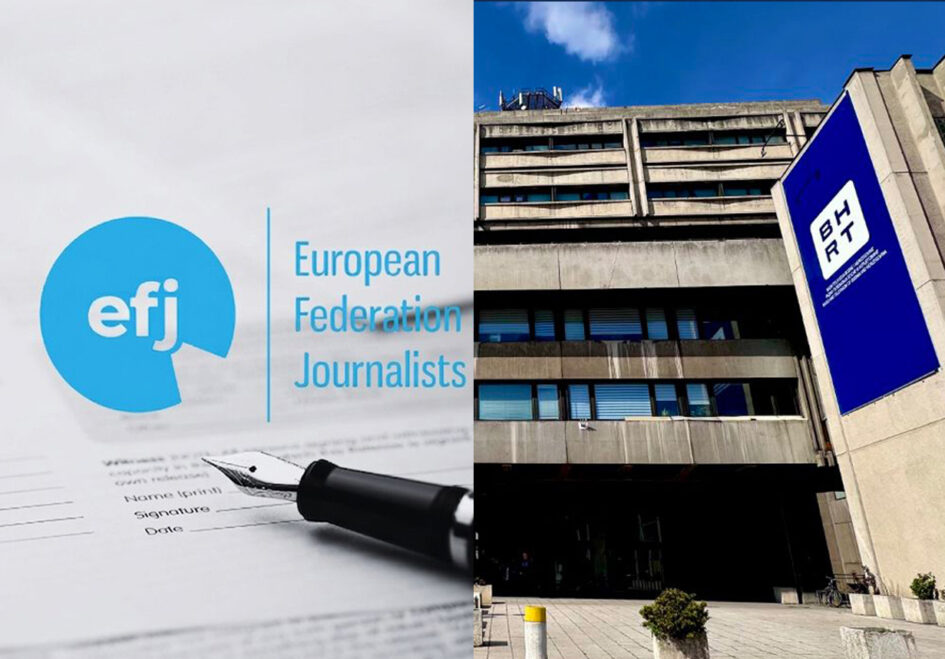
The European Federation of Journalists (EFJ) joins its affiliate, Bosnia-Herzgovina Journalists’ Association (BHN), in warning that BHRT, Bosnia and Herzegovina’s public service broadcaster, is on the verge of shutting down, and in calling for urgent action from Bosnian and European institutions to prevent its possible collapse, the EFJ announced following yesterday’s statement by BH Journalists.
BHRT has been in a long-standing financial and institutional crisis, but the situation has now reached a point where the broadcaster’s very survival is at risk. Last week, BHRT was forced to start reducing its programming due to a lack of funding, while its bank accounts have been blocked for over a month. There is now growing uncertainty over whether employees will receive their salaries. More than 700 journalists, editors, producers, camera operators, technicians and other media workers are facing the very real possibility of losing their jobs.
EFJ affiliate BH Journalists (BHN) warned on 21 September:
“Closing BHRT would not mean the disappearance of only one television and one radio programme, but the collapse of the entire public broadcasting system consisting of BHRT, RTVFBiH and RTRS, and their capacity to provide citizens with functional, pluralistic and publicly accountable information.” BH Journalists (BHN) added that Bosnia and Herzegovina could become the only country in the Western Balkans without a state-level public service media outlet.
This is not the first time EFJ and its affiliates have raised alarm on this issue. In January, the EFJ, together with its Media Freedom Rapid Response (MFRR) partners, voiced serious concern to the High Representative for Bosnia and Herzegovina, Christian Schmidt, over the lack of political action on the future of BHRT. There has been little improvement since. Unions across Bosnia and Herzegovina have also expressed their support for BHRT and its employees.
“This is about much more than the survival of one television and one radio service. It is about the right of the citizens of Bosnia and Herzegovina to independent and reliable information, and about more than 700 people working at BHRT who must not become the victims of years of political and institutional blockages. Public service media cannot be independent if they are constantly forced to fear whether they will be able to pay salaries and continue broadcasting. We must act now, while there is still time to prevent BHRT from shutting down,” said EFJ President Maja Sever.
More than a national issue
The EFJ has consistently advocated for strong, independent and sustainably funded public service media across Europe. Public service media are not an optional expense that governments can abandon in times of political or financial crisis: they are part of our democratic infrastructure and one of the key guarantees of citizens’ right to credible, pluralistic and independent information. This principle is strongly reflected in the European Media Freedom Act (EMFA), which sets a clear European standard for editorially and functionally independent public service media, supported by adequate, sustainable and predictable financial resources.
Bosnia and Herzegovina is not a member of the European Union, but as an EU candidate country it is expected to move towards European standards on media freedom, media pluralism, independent public service media and democratic institutions. The crisis at BHRT therefore cannot be treated merely as an internal matter for Bosnia and Herzegovina.
Call to action
The EFJ joins BH Journalists in calling for the immediate resolution of the blockade of BHRT’s bank accounts, the collection and distribution of license fee revenues in accordance with the law and final court decision, and the establishment of a stable, transparent and independent funding model for public service broadcaster that prevents political and institutional blockages.
The EFJ calls on the Parliamentary Assembly and the Council of Ministers of Bosnia and Herzegovina to take immediate and concrete steps to secure the continued operation of BHRT and protect its more than 700 media workers. At the same time, we call on the European Commission, the EU Delegation to Bosnia and Herzegovina and other European and international institutions to treat the BHRT crisis as an urgent issue of media freedom, media pluralism and democratic resilience.
The sustainability and independence of public service media should also be addressed in the assessment of Bosnia and Herzegovina’s progress on its path towards EU membership, and the authorities should be asked to provide a concrete, time-bound plan to resolve the crisis and establish a sustainable funding system for BHRT.
BHRT funding campaign
In the meantime, BHRT itself has launched a campaign appealing directly to the public for support, addressing all socially responsible business entities, institutions and individuals:
“We need financial support in the fight to preserve the signal, because the institutions of our country and international representatives do not want to provide us with stable systemic funding. BHRT is not just a radio and television station. We defend the signal that has connected this country for decades, in good times and bad,” the BHRT states.
BHRT is still broadcasting. More than 700 people are still doing their jobs. This is precisely why we must act now, while there is still time to prevent Bosnia and Herzegovina from losing its state-level public service broadcaster.


