
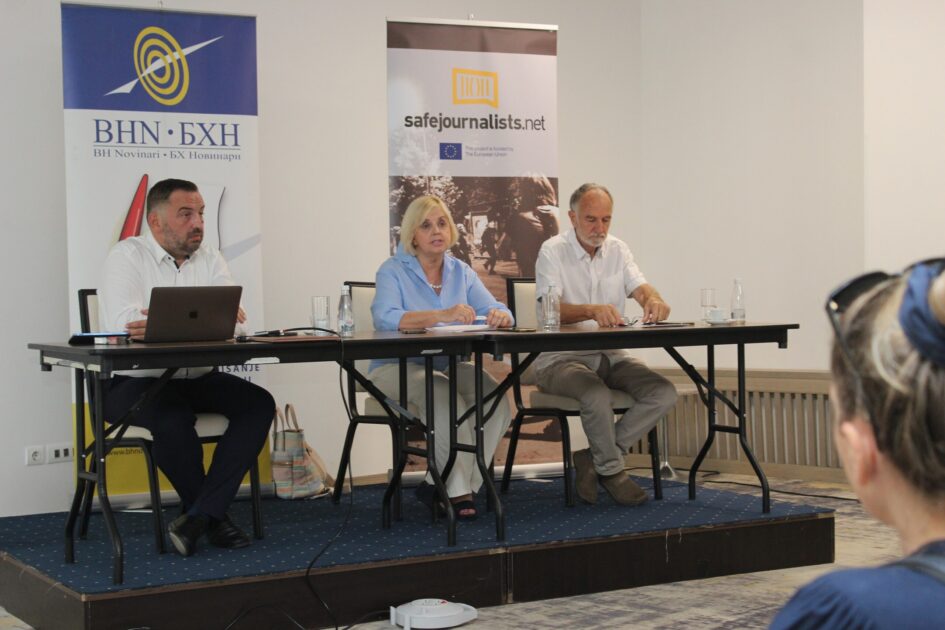
Sarajevo, September 3, 2026 – Preliminary results of the first phase of research on the political programmes, policy objectives and practical engagement of political parties and their officials in the field of media freedom and the protection of journalists’ rights and safety in Bosnia and Herzegovina for the period 2022–2026 were presented in Sarajevo today.
“When conducting this research, we made sure to take into account that declarative support for freedom of expression, declarative support for journalists’ safety, or declarative support for European standards in the field of media, media content and everything related to the media is not enough. Such declarative support had to result in a certain type of policy,” said Prof. Dr Amer Osmić, author of the research “From Promises to Accountability: Political Parties, Media Freedom and Journalists’ Safety in BiH,” at the presentation.
He added that, following the declarative support, the research examined whether specific policies had been initiated that would improve the state of freedom of expression, journalists’ safety and the implementation of European standards:
“When it comes to the measurability of political promises, no adequate measures, activities, deadlines, budgets or, which is very important for monitoring, indicators were offered that would allow you to track the implementation of those promises within defined deadlines. None of these elements exist in any of the political options in BiH that we analysed,” he explained, noting that the analysis did not monitor party programmes as such, but examined publicly available data on party websites and official social media profiles:
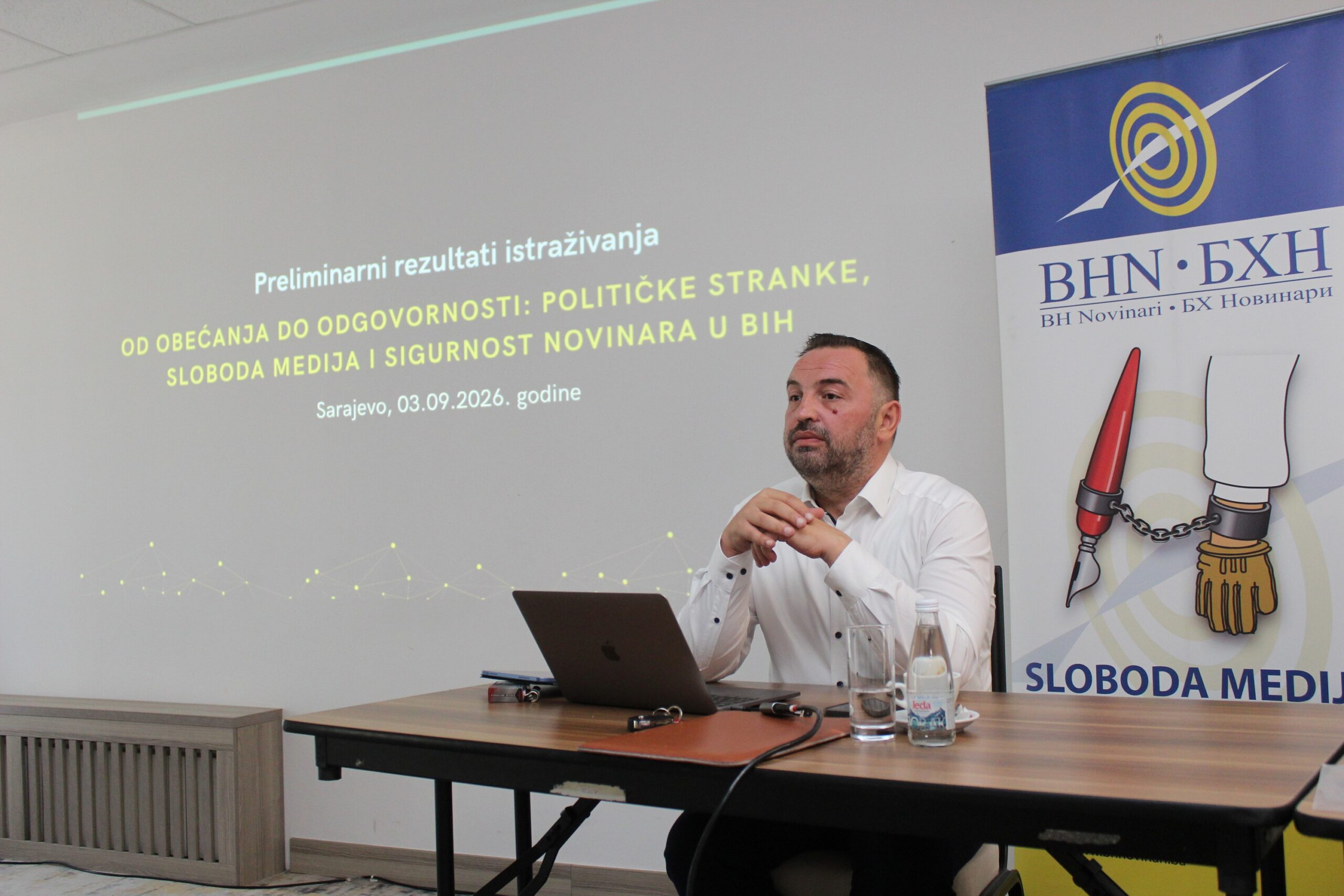 “These are not results with which we want to give anyone a poor assessment or give one party a better and another a worse assessment. With these results, we want to encourage political options to discuss with us the elements that can be integrated into programmes they have yet to publish.”
BH Journalists analysed the programmes, action plans and declarations of 15 political parties participating in government at all levels and registered to contest the 2026 General Elections. The aim is to encourage political parties to support media freedom and journalists’ safety much more responsibly than before, strategically and over the long term, as part of European values and BiH’s objectives on its path towards European Union membership.
“We have seen that ad hoc solutions are being adopted in the media sector and in the area of journalists’ safety, which are not the result of considered party policies towards the media, but rather individual decisions and the ‘feeling’ of individual political leaders that the media should be disciplined or that the media environment should be shaped in some other way,” warned Borka Rudić, Secretary General of BH Journalists, at the presentation. She particularly highlighted as problematic the fact that individual proposals by party leaders in the legislative and executive branches of government were turned into laws that have had a drastic and negative impact on media freedom in BiH:
“The first is the one that has been mentioned publicly several times, namely that BiH has fallen 26 places in the Reporters Without Borders ranking over the past three years, which is a direct consequence of amendments to the legal framework, primarily the criminalisation of defamation in Republika Srpska, but also the inefficient prosecution of attacks and threats against journalists.”
Marko Divković, President of the BH Journalists Association, said that the results of analyses such as this one personally concern him, given that, based on past experience, they generally show that we are constantly regressing when it comes to media freedom:
“Some 15–16 years ago, Bosnia and Herzegovina, measured by the World Press Freedom Index, was in a fantastic 37th place. The same people to whom we will send these data and proposals have spent all this time working to the detriment of journalistic and media freedoms. That is why we are where we are today, somewhere around 90th place. Let’s not compare ourselves with those who are worse; let’s compare ourselves with those who are better,” he said, noting that almost ten years ago the Association submitted proposals to parliamentarians for the adoption of three laws, the results of which would probably have been much more favourable today had they been adopted:
“These were the Law on Media Ownership, the Law on Advertising, and a law that would, in fact, improve the overall situation and journalists’ sense of safety with just one provision, by making an attack on a journalist while performing their professional duties a criminal offence prosecuted ex officio. So, ten years have passed, and only two years ago we received a bureaucratic response that our requests, our proposals, had been received and registered somewhere in some protocol. And that is all.”
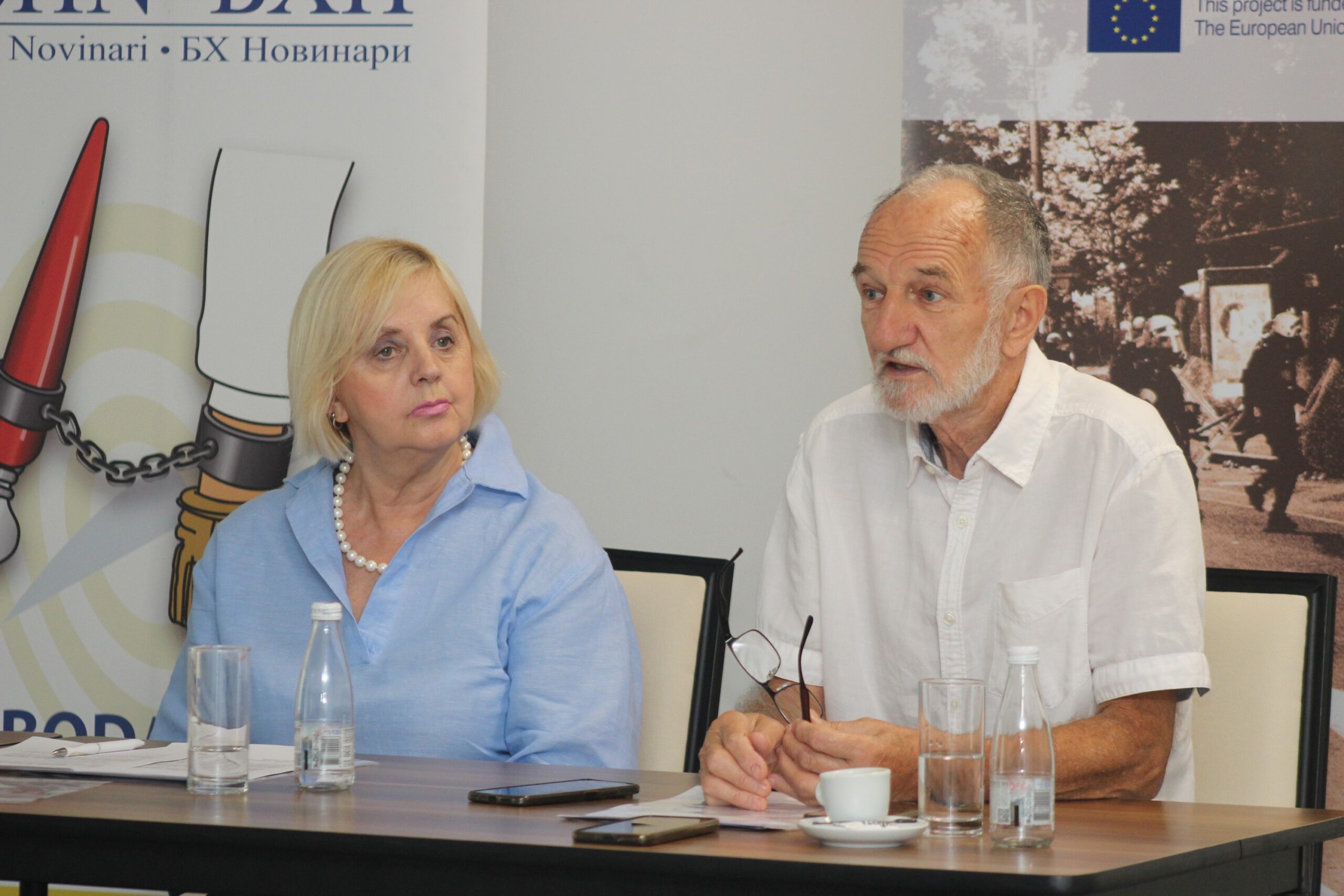 Borka Rudić concluded that a comprehensive strategy would enable the media and journalistic community, through dialogue with the authorities, legitimate pressure, advocacy and lobbying, to work towards the adoption of laws in line with European standards:
“Everything that has happened over the past three years, during the period when BiH was granted candidate status, has in fact shown that we have a legal framework that is not in line with European standards and that we seriously need to work on creating new ways of advocating for European legislation through the process of European Union integration.”
BH Journalists therefore advocates a strategic approach based on EU standards to creating the legal, institutional and social environment needed to protect media freedom and the safety of journalists. For this reason, BH Journalists is launching a four-year Advocacy Campaign to strengthen media freedom and improve criminal justice legislation concerning the safety of journalists in BiH.
“Through this advocacy campaign, we want to raise the issue of the responsibility of political parties and institutions for improving media freedom and journalists’ safety. In the period 2026–2030, we will advocate for amendments to criminal legislation; protection of journalists from threats and violence; harmonisation of BiH legislation with European standards on transparency of media ownership, public funding of the media, the independence of public service media and regulators; as well as the establishment of a Fund to support media outlets and the production of pluralistic media content,” Borka Rudić explained.
“At the same time, the campaign also aims to involve citizens as active media consumers and rights-holders with regard to access to information and pluralistic media content created in the public interest, rather than for political and other centres of power,” she added.
MAIN ADVOCACY PRIORITIES OF BH JOURNALISTS:
Areas that we want to improve through the advocacy campaign following the formation of the new government after the October 2026 elections, and for which we will seek answers and greater engagement from the newly elected authorities and political parties that form the government. These areas are:
- Criminalisation of attacks and threats against male and female journalists and other media workers in order to ensure more effective investigations and sanctions against perpetrators (one of the requirements from the annual reports and an EU accession condition);
- Adoption of a Law on Transparency of Media Ownership and Media Pluralism (another requirement from the European Commission’s reports on BiH’s progress towards EU integration);
- Establishment of a Fund to Support Media Outlets and the Production of Pluralistic Media Content at the state level (this could be part of the Law on Transparency of Media Ownership);
- Adoption of rules and procedures for transparent financing of media outlets from public budgets.
Additional objectives:
- Political, functional and financial independence of the Communications Regulatory Agency – through the adoption of a new Law on Electronic Communications;
- Public service broadcasting – in the short term: (a) resolving the debt between BHRT, RTVFBiH and RTRS; (b) adopting amendments to the Law on the Public Broadcasting System concerning the distribution of the broadcasting fee, with new distribution models (40:30:30%); and in the long term:
- Adoption of a state-level Law on Advertising;
- Improvement of the Law on Freedom of Access to Information at the state level and harmonisation of legislation at the state and entity levels, as well as in the Brčko District.


